Do I Read Ac Gauges When Fan Is on
Using Gauges for Troubleshooting
Gauge pressure is the kickoff tool in Air-conditioning troubleshooting. The tabular array below shows 7 Approximate Readouts that yous may encounter. Use the Gauge Readout Tool separately or in combination with the table of Gauge Diagnostics for Air conditioning troubleshooting.
Estimate Readout Tool
Normal Conditions
Air in cooling organisation (insufficient suction)
Defective expansion valve
Excessive refrigerant
Moisture Intrusion
Refrigerant does not broadcast
Summary Table of Judge Diagnostics
Normal Conditions
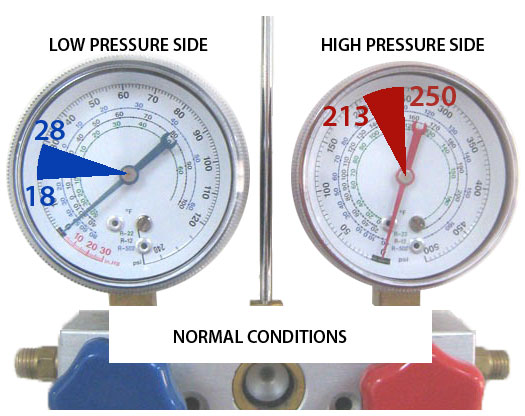
1 Atmosphere
Room Temperatures of 30-38 C (86 - 96 F)
Engine speed of approx. 1500 rpm or nigh 75% of rated engine speed
Back to Height
Air in cooling organization (insufficient suction)
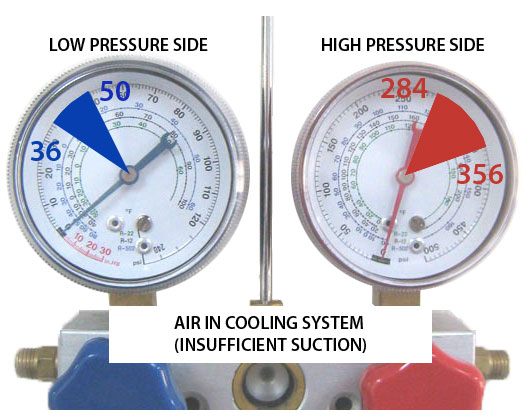
Pressure Range
Low side: 36 to 50 psi
High side: 284 to 356 psi
Indications
Both pressures are TOO High
The low-side pipage is not cold
Causes
Air in the arrangement
Remedy
Evacuate the organisation
Replenish the refrigerant
Check the gauge readings
If prolonged operation with air in the system, the liquid tank must exist replaced.
Back to Tiptop
Defective expansion valve
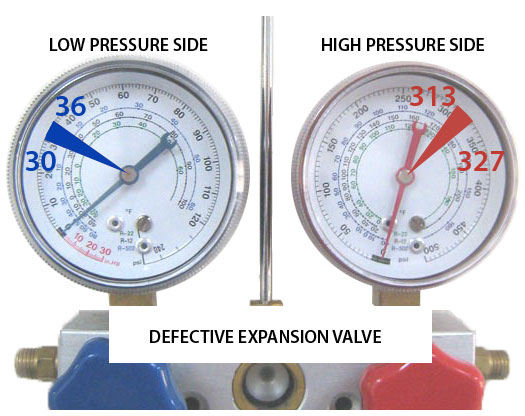
Pressure Range
Low side: thirty to 36 psi
Loftier side: 313 to 327 psi
Indications
Both pressures are TOO High
Causes
Improper refrigerant charge
Lacking expansion valve
Improper temperature sensor installation
Remedy
Verify refrigerant charge
Check temperature sensor installation and insulation
If the refrigerant charge is okay and the temperature sensor installation and insulation are right then replace the expansion valve.
Back to Top
Excessive refrigerant
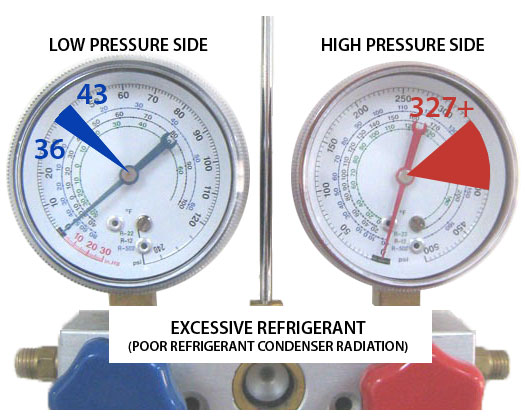
Pressure Range
Depression side: 36 to 43 psi
High side: 327+ psi
Indications
Both pressures are TOO Loftier
Causes
Force per unit area increase due to excessive refrigerant
Insufficient condenser cooling
Remedy
Verify the refrigerant level
Clean the condenser
Check and adjust the fan belt and / or the condenser fan motors
Back to Meridian
Moisture Intrusion
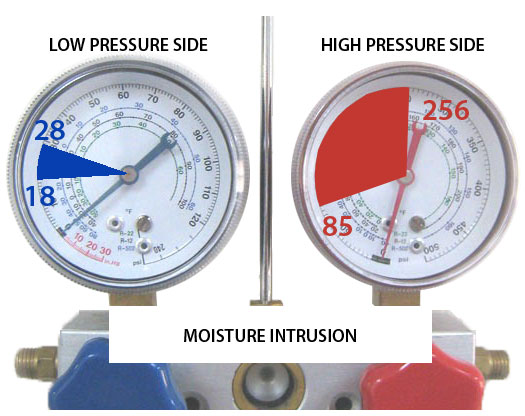
Pressure Range
Depression side: 18 to 28 psi
Loftier side: 85 to 256 psi
Indications
Low pressure side alternates between a vacuum and normal pressure level
Causes
Wet has frozen in the air conditioner organisation, bottleneck the expansion valve.
Remedy
Evacuate the organization
Supercede the receiver dryer
Recharge the system
Back to Top
Refrigerant does not broadcast
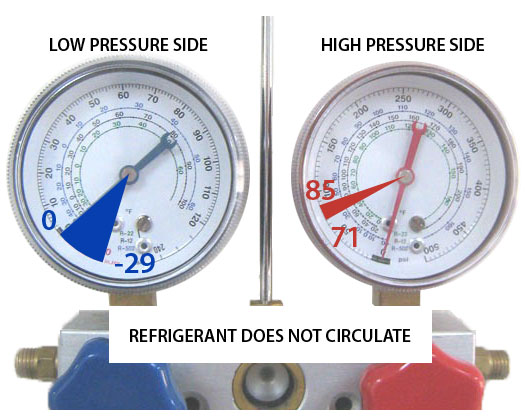
Pressure Range
Low side: 0 to -29.99 psi
High side: 71 to 85 psi
Indications
Low pressure side becomes a vacuum
High pressure every bit listed above
Frost or condensation on the front and rear pipe connections of the receiver dryer or expansion valve
Causes
AC system is blocked by contamination or ice
AC organisation is shut off by defective expansion valve or tempeerature sensor
Air conditioning line from evaporator to compressor has kink in the line
Remedy
Terminate OPERATION IMMEDIATELY
Check for contamination or ice
If moisture is found then evacuate the system
If the expansion valve is defective then replace it
Replace receiver dryer
Recharge with refrigerant to proper level
Repair whatsoever kinked hoses
Dorsum to Top
Summary Tabular array of Guess Diagnostics
Low Force per unit area Side is Too HIGH
The low pressure side normally becomes besides high when the high pressure side is too loftier.
| Crusade | Inspection | Remedy |
|---|---|---|
| Defective Thermoswitch | The magnetic clutch switch turns off before the outlet air temperature is sufficiently low. | Supercede the thermoswitch |
| Poor Expansion Valve temperature sensor contact | The high and depression pressure sides guess pressures equalize when the magnetic clutch is turned off (inside a short fourth dimension elapsing) | Replace Compressor |
| Expansion Valve opens too far | Frost has adhered to the suction hose / pipe | Install the temperature sensor against the low pressure level pipage and cover with insulating record. |
| Clogged compressor suction filter | Compressor plumbing fixtures is cool but the low pressure hose is non. | Remove and clean the filter. |
Low Force per unit area Side is TOO Depression
| Cause | Inspection | Remedy |
|---|---|---|
| Insufficient Refrigerant | There is picayune temperature difference between the low and loftier pressure sides. | Repair any leaks and recharge the refrigerant to the correct levels. |
| Clogged liquid tank (receiver dryer, accumulator) | Considerable temperature departure betwixt the inlet and outlet sides of the receiver dryer during operation. Also, tank may exist frosted | Supercede liquid tank (receiver dryer) |
| Chock-full expansion valve | Expansion valve inlet side is frosted. Generally the low side force per unit area is nearly vacuum. | Replace expansion valve. |
| Expansion valve temperature sensor gas leak (damaged capillary tube, etc..) | Expansion valve outlet side is chilled and low pressure side is Depression. | Make clean or replace expansion valve. |
| Clogged or blocked pipe | Low pressure readings decrease or a negative reading is shown. Indicates pipage is chock-full or blocked between the evaporator roll and the compressor. A frost spot may indicate the point of blockage. | Clean or supervene upon pipage. |
| Defective thermoswitch (common cold command) | Evaporator is frozen showing ice along the face of the coil, not just frost on the manifolds of the coil. | Adjust temperature sensing tube to a libation part of the coil or supervene upon the thermoswitch. |
High Pressure level Side is Besides HIGH
| Crusade | Inspection | Remedy |
|---|---|---|
| Poor Condenser cooling | Dirty or clogged condenser fins, Cooling fans do not operate correctly. | Clean and / or repair the condenser core / fans. |
| Excessive refrigerant | Verify by gauge reading | Utilize your refrigerant recovery equipment to capture excess refrigerant. Charge to the correct refrigerant levels. |
| Air in the system | Pressure is high on both loftier and low sides | Evacuate, vacuum and recharge with refrigerant. |
High Pressure level Side is TOO LOW
| Cause | Inspection | Remedy |
|---|---|---|
| Insufficient refrigerant | Trivial temperature difference between the low and high pressures. | Repair any leaks and recharge the refrigerant to the correct levels |
Source: https://www.perrinmfg.com/resources/gauge-diagnostics
0 Response to "Do I Read Ac Gauges When Fan Is on"
Postar um comentário